Join LuxCitizenship for our 10-Year Anniversary Celebration | RSVP Here


Our Research
The LuxCitizenship Study 2024
A Study of the Luxembourgish Dual Nationals in the Americas
Published: November 2024 | Written by: Daniel Atz and Lauren Lowell | Edited by: Sylvia Power | Publisher: Connaissance Solutions LLC, New York
The LuxCitizenship Study 2024 is the fifth edition of the annual research report on the Luxembourgish dual nationals of the Americas: the people in the United States, Brazil and Argentina who have reclaimed Luxembourgish nationality through an ancestor since Luxembourg’s 2008 reform of its Nationality Act. According to the study, the number of dual nationals through ancestry across the three countries surpassed 40,000 in 2024. The report documents who these new Luxembourgers are, why they applied, and what their growing numbers mean for Luxembourg.
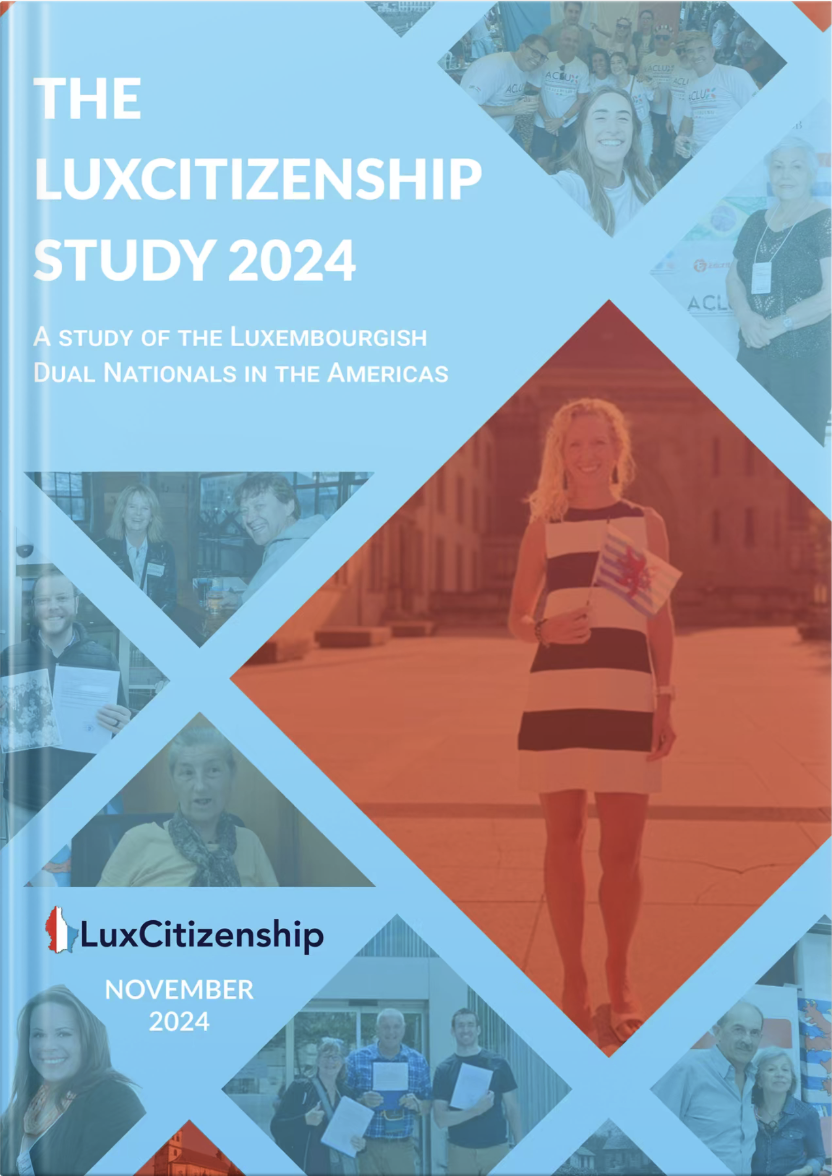
The complete study is available to read and download as a PDF: The LuxCitizenship Study 2024 (PDF, 113 numbered pages). It is also held in the library of the Centre de Documentation sur les Migrations Humaines in Dudelange, Luxembourg; see Publication Details below. The ebook edition (ISBN 979-8-9982322-1-3) is sold on Google Play Books and can be previewed, with its full bibliographic record, on Google Books.
About the Study
LuxCitizenship launched the first edition of this research in 2018, focused on the United States. Brazil was added in 2021 and Argentina in 2023, as the numbers of new nationals in those countries made a comparative study necessary. The 2024 edition presents all three populations in one volume and closes with a Final Report that compares them directly.
The study draws on three kinds of evidence. The first is Luxembourg government data: the Registre National des Personnes Physiques (RNPP) series on Luxembourgish nationals living abroad, and the Ministry of Justice statistics on nationality procedures. The second is an original survey of 1,174 confirmed Luxembourgish dual nationals through ancestry, written in the native language of each country by native speakers and promoted with the Luxembourg Brotherhood of America, the Association of Luxembourgish Citizens in Brazil and the Argentine Luxembourg Association as partner organizations. The third is historical analysis of nineteenth-century Luxembourgish emigration to each country, and of how Luxembourg’s nationality law evolved from the Napoleonic Code to the 2008 and 2017 reforms that made the present recoveries possible.
As the opening letter puts it, the goal is not only to understand who these new Luxembourgish nationals are, but to anticipate the effects their presence may have on Luxembourg. The full methodology, including verification and confidence levels, is documented on our Research Methodology & Data page.
What the Study Covers
Luxembourg Public Data
The opening chapters set out the scale of the phenomenon from official sources. According to the Ministry of Justice, 40,641 adults had recovered Luxembourgish nationality through an ancestor alive on 1 January 1900 (the Article 89 procedure) as of 1 January 2024, including 12,269 Brazilians and 3,797 Americans. RNPP figures for 30 June 2024 put the number of Luxembourgish nationals living in the United States at 16,111, in Brazil at 28,574 and in Argentina at 587. Taken together, the population in the three countries grew from 8,712 on 30 June 2019 to 45,272 five years later, an increase of 420 percent, and in August 2023 Brazil overtook Belgium as the foreign country with the second-largest number of resident Luxembourgish nationals.
History of Luxembourgish Nationality Law
A chapter on the history of the law traces the path from the Napoleonic Code’s jus sanguinis and its loss-of-nationality rules for women, through the nationality laws of 1934, 1968 and 1986, to the 2008 law that first allowed Luxembourgers to hold multiple nationalities and opened recovery to descendants of any Luxembourgish national alive on 1 January 1900. The 2017 revision carried that provision into Article 89 and added Article 23 for those with a Luxembourgish parent or grandparent; the deadline for the in-person declaration was extended to 31 December 2025.
Three Country Studies
The body of the report is organized by country. For each of the United States, Brazil and Argentina there is a chapter on the Luxembourgish ancestors who emigrated there, a demographic portrait of today’s dual nationals, and a survey chapter on how they use their nationality and see their future with Luxembourg. The American section adds an analysis of application motivations and a case study of Minnesota’s Luxembourgish dual nationals. From the 1,174 respondents, the research team identified 333 Luxembourgish ancestors: 225 for the 416 American respondents, 80 for the 634 Brazilians and 28 for the 124 Argentines.
Final Report and Appendices
The Final Report, Who Are the Luxembourgers in the Americas?, compares the three populations on nationality and passports, demographics, education and career, geography, migration, language, and motivations. Two appendices follow: a sentiment analysis of dual citizens’ voting intentions in Luxembourg’s 2023 national elections, and a guide to the interactive research pages on this site. A bibliography and a short note about LuxCitizenship close the volume.
Selected Findings
Pride in Luxembourgish heritage was the most common reason respondents gave for applying, cited by 72.9 percent, followed by consideration for the future of their children and grandchildren at 68.5 percent. These were the two leading motivations in each country. The populations diverge on a third factor: 56 percent of American respondents said recent political or social events in their home country motivated their application, compared with 22.6 percent of Brazilians and 16.1 percent of Argentines.
Across the three countries, 74 percent of respondents had traveled to Luxembourg at least once and 5 percent were living there; 43 percent held a valid Luxembourgish passport, ranging from 15 percent of Argentines to 31 percent of Americans and 52 percent of Brazilians. A majority, 57 percent, expressed interest in moving to Luxembourg or elsewhere in Europe, and 79 percent in learning Luxembourgish. Sixty-eight percent had pursued education beyond high school, and 26 percent held a master’s or doctoral degree.
Source: LuxCitizenship surveys of 416 American, 634 Brazilian and 124 Argentine dual citizens; Argentine percentages are of those who answered the question; respondents could choose multiple answers · 2024
The study also maps where the dual nationals live. Just over half of American respondents were in Minnesota, California, Illinois, Wisconsin and Colorado; 65.3 percent of Brazilian respondents were in Santa Catarina and Paraná; and 79.8 percent of Argentine respondents were in Buenos Aires, Santa Fe and Entre Ríos. One measure of how differently the communities are organized is the number of survey respondents per identified ancestor: 1.7 in the United States against 7.4 in Brazil, where 98 descendants of a single emigrant, Nicolas Bley, took the survey.
All figures on this page are taken from the study itself; the report states its sources, confidence levels and margins of error in the Methodology chapter and in footnotes throughout.
Authors and Editor
Daniel Atz founded LuxCitizenship in 2016 and has led its research on Luxembourg’s dual nationals since the first edition in 2018. Lauren Lowell is co-author of the study and is credited for research and design. The 2024 edition was edited by Sylvia Power.
Image: From left: Daniel Atz, Founder of LuxCitizenship, and Lauren Lowell, Head of Operations, co-authors of The LuxCitizenship Study 2024.

Publication Details
| Title | The LuxCitizenship Study 2024 |
|---|---|
| Subtitle | A Study of the Luxembourgish Dual Nationals in the Americas |
| Authors | Daniel Atz and Lauren Lowell |
| Editor | Sylvia Power |
| Publisher | Connaissance Solutions LLC (a Delaware limited liability company, d/b/a LuxCitizenship) |
| Publisher address | 500 7th Avenue, Floor 8, New York, NY 10018, United States |
| Place of publication | New York, NY, United States |
| Date of publication | November 2024 |
| Edition | Fifth edition of LuxCitizenship’s annual study (first edition 2018) |
| Language | English |
| Format and extent | Paperback and ebook (EPUB); 113 numbered pages (118 pages including front matter). Also distributed as a digital PDF. |
| Copyright | © 2024 Connaissance Solutions LLC. All rights reserved. |
| ISBN | 979-8-9982322-0-6 (paperback); 979-8-9982322-1-3 (ebook, EPUB). Both registered to Connaissance Solutions LLC. |
| Where to buy or preview | Ebook: Google Play Books (US$12.50). Preview and bibliographic record: Google Books (volume ID 2pgQEgAAQBAJ). |
| Library holding | Centre de Documentation sur les Migrations Humaines (CDMH), Dudelange, Luxembourg; system code 140-5-761-11410-9, call number 25AD81 STAT |
| Permissions and inquiries | info@luxcitizenship.com |
Library Holding
The study is held in the library of the Centre de Documentation sur les Migrations Humaines (CDMH) in Dudelange, Luxembourg, under system code 140-5-761-11410-9 (call number 25AD81 STAT); the catalog record is public. The CDMH is dedicated to the study of migration in Luxembourg and the Greater Region.
How to Cite This Study
Chicago (bibliography):
Atz, Daniel, and Lauren Lowell. The LuxCitizenship Study 2024: A Study of the Luxembourgish Dual Nationals in the Americas. Edited by Sylvia Power. New York: Connaissance Solutions LLC, 2024. https://www.luxcitizenship.com/the-luxcitizenship-study-2024/.
APA (7th edition):
Atz, D., & Lowell, L. (2024). The LuxCitizenship Study 2024: A study of the Luxembourgish dual nationals in the Americas (S. Power, Ed.). Connaissance Solutions LLC. https://www.luxcitizenship.com/the-luxcitizenship-study-2024/
Related Research
The country chapters of the 2024 edition are also published as interactive pages: The American-Luxembourgers, The Brazilian Luxembourgers and The Argentine-Luxembourgers, each with companion pages on ancestors and survey results. Our quarterly analysis of the RNPP and Ministry of Justice figures continues at Luxembourg Public Data Research, and earlier editions are collected under Our Past Case Studies. All of our research is indexed at Our Research Studies. In July 2023, Luxembourg’s open-data portal profiled this research program in Sur la trace des Luxembourgeois outre-Atlantique.
Research team for the 2024 edition: Daniel Atz (lead), Lauren Lowell (research & design); editor Sylvia Power. For press inquiries about this research, contact info@luxcitizenship.com.