

How Many People Are Eligible for Luxembourg Citizenship? 5 Years of Data
Open data · five full years · 2021–2025
How many people are actually eligible for Luxembourg citizenship?
You’ve probably just taken our eligibility test, or you’re about to. Here’s what happened to the 4,683 people who did between 2021 and the end of 2025 — how many qualified, which path they landed on, and how all of that shifted across five years.
All figures cover 1 January 2021 through 31 December 2025. We publish this once a year, after each annual report.
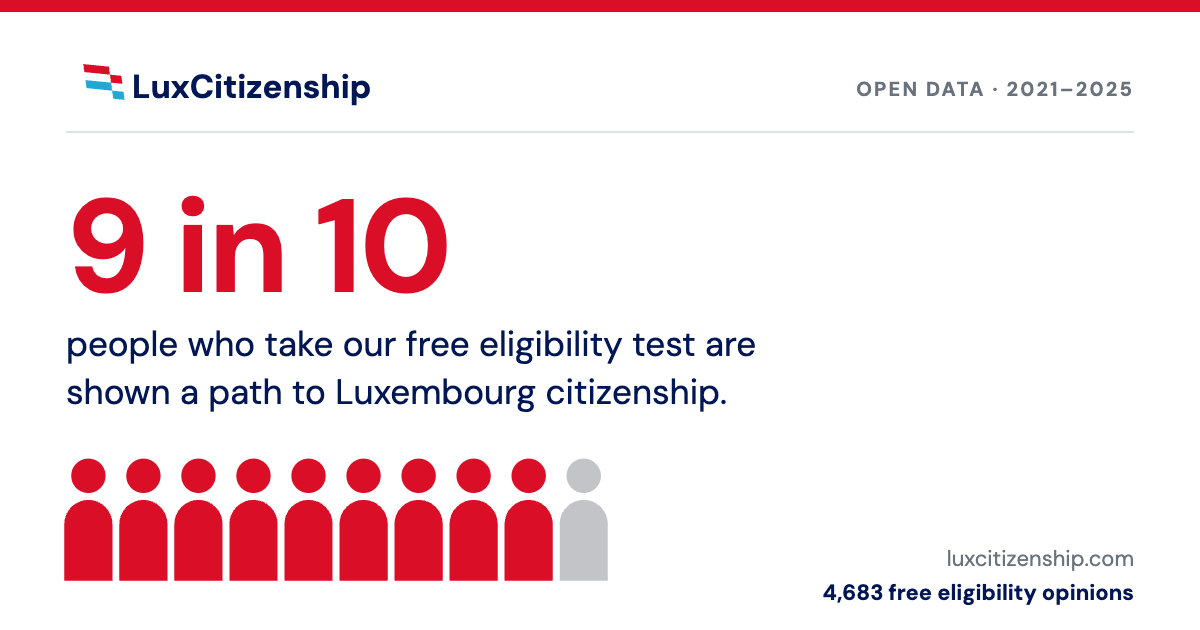
people who take our eligibility test are shown a legal path they can apply through.
Across five years the eligible share has ranged from 83% to 92%. It has never dipped below eight in ten.
First, what this data is
Where these numbers come from
Our eligibility test is a free form on this site. You answer up to 30 questions about your family — where your ancestors were born, when, and who was born after whom. The questions branch, so what you’re asked next depends on what you just said.
At the end, software checks your family line against Luxembourg’s Nationality Act of 2017 and tells you which path, if any, is open. No human reads it first. In 2025 the tool handled 99% of entries automatically, up from 95% when we started.
It costs nothing, and most people who take it never become clients. That’s what makes it worth publishing: it’s a wide, honest picture of who’s knocking on the door — not just of who hires us.
The headline number
The eligible share barely moves
Year after year, roughly the same proportion of people qualify. Three times as many now take the test as in 2021 — and the odds have stayed almost exactly the same.
Share of test-takers shown an eligible path
Article 7, Article 7/23, Article 23 and Article 89 results combined.
Share told they don’t qualify
The steadiest figure we publish. Five years, a two-point band.
Why so high? Because almost nobody takes this test at random. People arrive already suspecting they have a Luxembourgish ancestor — usually because of a family name, a story, or a document in a drawer. That self-selection is the single biggest thing to understand about this dataset.
Which route people get
Article 7 is the main road
Luxembourg law offers several ancestry-based routes to citizenship. Our test tells you which one fits your family line. One of them dominates — and has since we started counting.
What answer people got, by year
Each bar is 100% of that year’s opinions. Shares as published in each annual report.
Article 7
The most common result every single year. If you qualify, this is most likely your route. What Article 7 means →
Article 7 + 23
A combination result, including cases where only a parent or grandparent qualifies directly. Steady at about a quarter of all opinions.
Article 23
A narrower route with its own conditions. Small but remarkably consistent — it has not moved more than a point in five years.
Article 89
Once 2% of results, down to zero by 2024. This path closed permanently on 31 December 2025 and is no longer available to anyone.
The mix is remarkably stable
Article 7 has never fallen below half. Article 23 has never left the 6–7% band. Whatever changed over five years, it wasn’t the law or who it reaches.
Article 89 faded on schedule
The data saw the closure coming years out — the share was already near zero long before the legal deadline arrived.
Demand over time
Three times as many people are asking
Demand didn’t creep up steadily. It sat flat for three years, then stepped up twice. 2025 was our busiest year by a wide margin — about 127 people a month.
Free eligibility opinions issued per year
4,683 in total across five years, a 190% increase from 2021 to 2025.
Growth is about discovery, not eligibility
If the rules held steady and the result mix held steady, then the tripling isn’t more people becoming eligible. It’s more eligible people finding out they always were.
Which raises an obvious question
Thousands of families have had this ancestry for a century. Why now? That’s what pushed us to start asking people directly.
Part two
So who are these people?
Everything above answers how many. It says nothing about who — or why someone decides that this is the year they finally look into their great-grandmother’s paperwork.
So in January 2024 we added one more thing to the end of the eligibility test. Not another dropdown. Just a blank box and a half-finished sentence:
“I want to become a citizen of Luxembourg because…”
Answering was optional and there were no suggested responses. By March 2025 we had about 1,500 answers, written by people in their own words. Read together, eight distinct reasons kept coming up. Those became the profiles below.
One difference worth noting: the figures above are counts drawn from the test itself. The profiles below come from what people wrote in their own words.
The short answer
Three reasons, in order
Group the eight profiles and it gets simple. Most people come for family. About a third come for opportunity. A small group comes for peace of mind.
- Family & cultureAncestry, family history, and love of the country itself56.2%
- Opportunity & mobilityWork, business, study, travel, and options for the children35.8%
- Security & stabilityA backup plan — financial, personal, or long-term8.0%
The detail
The eight profiles
From about 1,500 written answers, January 2024 to March 2025. Bars scaled to the largest group.
Heritage Seeker
47.5%“I have a huge family lineage connecting me to Luxembourg, and I want to embrace that history.”
Nearly half of everyone. Tracing a line back, honoring grandparents, closing a loop.
Pragmatic Expat
17.8%“Luxembourg offers a gateway to professional and business opportunities in the EU.”
Careers and business. A passport as a work tool.
Family Planner
9.6%“I want my children to have more opportunities and a stable future in Europe.”
Parents thinking a generation ahead — schools, healthcare, room to move.
Cultural Idealist
8.7%“I love the values and lifestyle of Luxembourg and want to be part of that community.”
Drawn to how the country works day to day, not to a family tree.
Global Citizen
8.4%“Dual citizenship fits my international lifestyle.”
Frequent travelers and remote workers. Many already live abroad.
Economic Refugee
5.2%“I want an alternative for financial security.”
Cost of living and job security. A hedge, described in money terms.
Political Dissenter
2.0%A small group who mention long-term concerns about institutions and government at home.
Safety Seeker
0.8%The smallest group. Mentions personal safety and wanting the option of somewhere calmer.
How we built the profiles
Four steps, nothing exotic
Nobody picked from a list. Every profile came out of what people typed into a blank box.
One open prompt at the end of the test. No suggested answers, no categories to pick from.
Split each answer into words, dropped filler like “the” and “and,” ranked what was left.
A sentiment tool rated how positive or negative each answer read.
Reading answers alongside the test data, eight reasons kept recurring. Those are the profiles.
Where an answer touched on more than one reason, we assigned it to the one the writer led with. Answers that gave no reason were left out of the count.
Open data
Every number on this page
All figures come from our published annual reports, 2021 through 2025. Open any panel for the full tables.
Full data tables
| Year | Opinions | Change | Per month | Automated | Eligible |
|---|---|---|---|---|---|
| 2021 | 526 | — | 44 | 95% | 92% |
| 2022 | 777 | +47.7% | 65 | 95% | 87% |
| 2023 | 750 | −3.5% | 60 | 98% | 87% |
| 2024 | 1,103 | +47.1% | 91 | 97% | 83% |
| 2025 | 1,527 | +38.4% | 127 | 99% | 86% |
| Total | 4,683 | +190% | — | — | — |
| Year | Art. 7 | Art. 7/23 | Art. 23 | Art. 89 | Not eligible | Research |
|---|---|---|---|---|---|---|
| 2021 | 234 · 58% | 106 · 26% | 26 · 6% | 9 · 2% | 27 · 7% | — |
| 2022 | 385 · 50% | 218 · 28% | 56 · 7% | 13 · 2% | 21 · 7% | 43 · 6% |
| 2023 | 419 · 55% | 180 · 24% | 54 · 7% | 11 · 1% | 58 · 8% | 29 · 4% |
| 2024 | 562 · 50% | 286 · 26% | 74 · 7% | 0 | 88 · 8% | 51 · 5% |
| 2025 | 774 · 51% | 427 · 28% | 111 · 7% | 0 | 128 · 8% | 58 · 4% |
| Profile | Share | Group |
|---|---|---|
| Heritage Seeker | 47.5% | Family & culture |
| Pragmatic Expat | 17.8% | Opportunity & mobility |
| Family Planner | 9.6% | Opportunity & mobility |
| Cultural Idealist | 8.7% | Family & culture |
| Global Citizen | 8.4% | Opportunity & mobility |
| Economic Refugee | 5.2% | Security & stability |
| Political Dissenter | 2.0% | Security & stability |
| Safety Seeker | 0.8% | Security & stability |
Notes on the data
- Source. LuxCitizenship annual reports, 2021–2025. Profile data from our own analysis of eligibility test responses, 2024–2025.
- Not a random sample. These are people who already suspected Luxembourgish ancestry. Not representative of Americans generally, or even of Americans with Luxembourg roots.
- Eligible share is the sum of Article 7, 7/23, 23 and 89 results for that year.
- Cite as: LuxCitizenship, “Luxembourg Dual Citizenship Eligibility Test Data, 2021–2025.” Questions: info@luxcitizenship.com
Common questions
What share of people are eligible for Luxembourg citizenship? About 9 in 10 people who take our test are shown a path they can apply through. Across five years the range has been 83% to 92%. Roughly 8% are told they don’t qualify and 4% need genealogical research first.
Which article applies most often? Article 7 — the top result every year, at 50–58% of all opinions.
How many people have taken the test? 4,683 free opinions between 2021 and 2025.
Is Article 89 still available? No. It closed permanently on 31 December 2025.
Why do most people apply? Family history. The Heritage Seeker profile is 47.5% of applicants, and family and culture together account for 56.2%.
Is the test free? Yes. Most people who take it never become clients.