Join LuxCitizenship for our 10-Year Anniversary Celebration | RSVP Here



Luxembourgish Ancestors: Brazil
Over 27,000 Brazilians have obtained Luxembourgish citizenship through ancestry in some form. But the story of their Luxembourgish ancestors is often shrouded in mystery. Who were these Luxembourgers and how did they end up in Brazil? Let’s dive into the story.
Updated: January 9th, 2024
Written by: Daniel Atz with Lauren Lowell
Share this Article:
To turn on the subtitles, please press the play button, followed by the CC icon. To change languages, click the gear icon and “Subtitles/CC”.
Background
634 Brazilian-Luxembourgers participated in our open survey of dual citizens through ancestry. From the 634 respondents, we obtained information on their 80 Luxembourgish ancestors. Because LuxCitizenship works with clients in the US, all participants were non-LuxCitizenship clients.
In this first section of our study, we dive into the story of Luxembourgish immigration to Brazil to explain who our dual citizens’ ancestors are and how their ancestors’ stories affect these people reconnecting with Luxembourg today.
Image: Luxembourger Nicolas BLEY who immigrated to Brazil in 1828 is believed to have 15,000 direct descendants, many who have obtained Luxembourgish dual citizenship.

About Luxembourg Migration to Brazil
When and why did Luxembourgers begin immigrating to Brazil?
Why Did Luxembourgers Migrate to Brazil?
Once upon a time, in 1815 specifically, Luxembourg regained its independence from France. The downside? It became a personal possession of the new Dutch king and was occupied by Prussian troops.
Back then, 80% of Luxembourgers worked in agriculture. Droughts would hit once every three years, constantly bringing their income to a halt.
The Dutch king didn’t help much and he wasn’t particularly bothered about Luxembourg. Although, he did love to tax their farmers.
Do you think that the other 20% of Luxembourg’s population was working in the banks? Think again. Absolutely no banks existed in Luxembourg until the 1850s. No banks, no capital.
Poverty and hunger pushed these Luxembourgers to look beyond their borders.
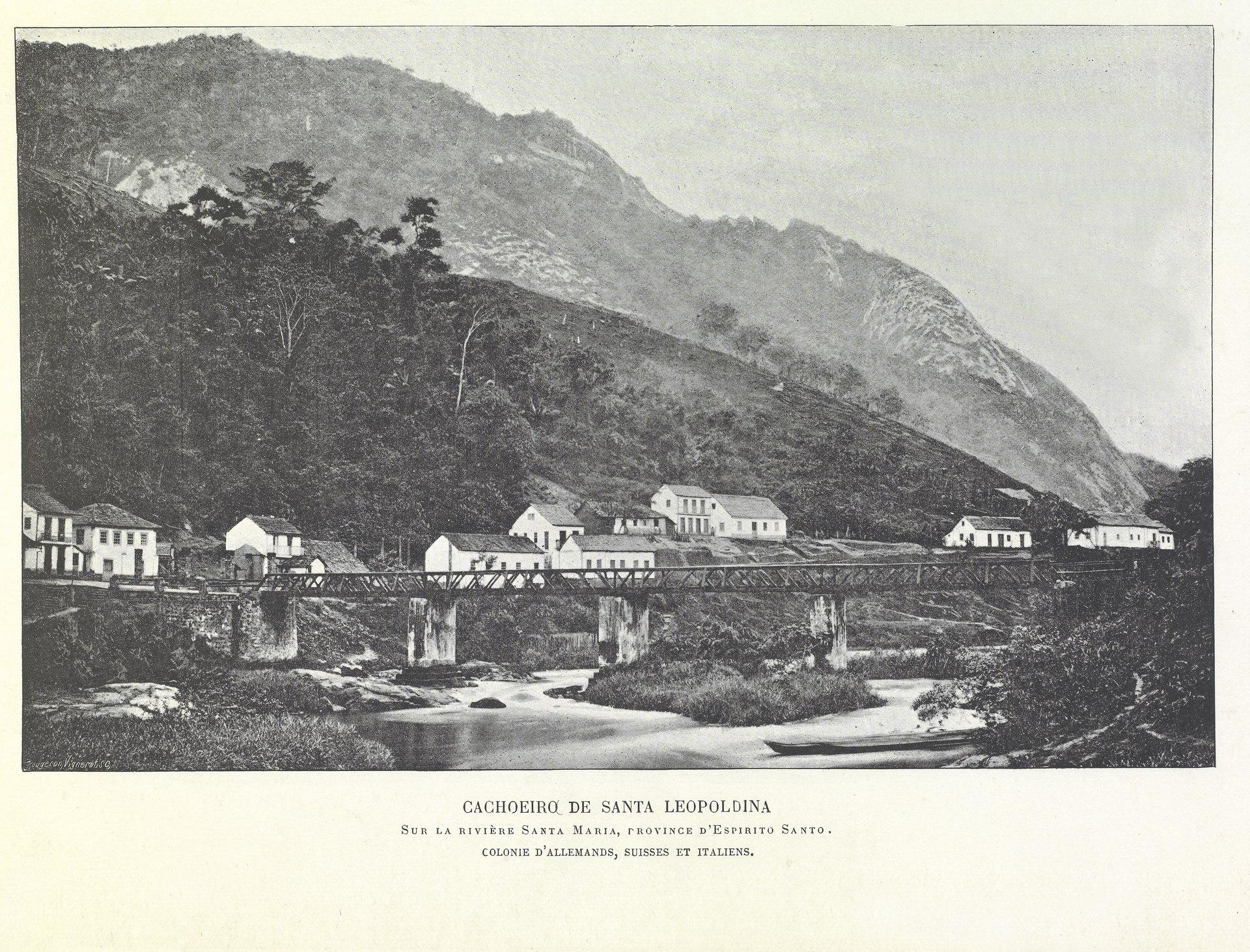
Image: Santa Leopoldina, 1899 – Pierre Émile Levasseur – Arquivo Nacional
Kind of a Bummer: The 1st 🇱🇺🇧🇷 Migratory Wave
In 1828, German travel agents came to Luxembourg and aggressively promoted migration to Brazil. They convinced around 2,500 Luxembourgish peasants, roughly 1.8% of the national population, to move. At the time, less than 100 Luxembourgers a year were leaving for the United States.
These “Brasilienfahrer”, Brazil-goers, set out for the port of Bremen in Germany. Tragically, most of them did not make it to Brazil. Instead of taking the Luxembourgers to Brazil, the travel agents beat and robbed two thirds of them before they got to Bremen.
70% of the families who set out for Brazil had to return to Luxembourg. Ashamed, or shunned by their communities, these now robbed Brazil-goers built a new community in the North of Luxembourg, first called Nei-Brasilien then eventually Grevels. In its first years, the town’s impoverished inhabitants survived by stealing potatoes from nearby farms.
Source: LuxCitizenship study of 80 ancestors of 634 Brazilian dual citizens · 2024
Saint Catherine, Save Us
At the very most, 100 Luxembourgish families made it from the Port of Bremen, Germany to Rio de Janeiro, Brazil.
While some of these Brazil-goers would move all around Brazil, the vast majority of them would head for what would become today’s Santa Catarina (Saint Catherine) state. Santa Catarina is located in Brazil’s South and is the country’s 10th largest state.
Many of the Luxembourgers would end up in Angelina, São Pedro de Alcântara, Antônio Carlos, and Santo Amaro da Imperatriz – all located in the hills outside of the state’s capital of Florianópolis. This proximity would later make Florianópolis one of the Brazilian cities with the most Luxembourger dual citizens today.
Video: Brazilian-Luxembourger Dual Citizen Paulo eloquently explains about his ancestors coming to São Perdo de Alcântara and the traditions and values they passed down. This was part of a 2020 video campaign at the outbreak of Covid-19.
Few Lessons Learned: The 2nd 🇱🇺🇧🇷 Migratory Wave
The second wave of Luxembourgish immigration to Brazil occurred from 1846-52. The migrants were set to leave through the Port of Dunkirk, France.
Although smaller in scale than the first wave in 1828, most of the second wave Brazil-goers met the same tragic fate. While some would actually make their way to Brazil, the majority either returned home after being robbed or changed their destination to Algeria.
Most of the Luxembourgers who migrated to Brazil during the second wave made their way to Santa Catarina and Espírito Santo (Holy Spirit) states. Espírito Santo is the state north of Rio de Janeiro state.
Over the decades, Luxembourgish communities were also set up not far from Porto Alegre, the capital of the Rio Grande do Sul state, the valleys of Itajaí (Santa Catarina), Rio Negro (Paraná), Curitiba (Paraná), among other places.
Source: LuxCitizenship study of 80 ancestors of 634 Brazilian dual citizens · 2024
#itgetsbetter: The 20th & 21st Centuries
The 20th and 21st centuries have seen numerous successful exchanges between Brazil and Luxembourg.
Following World War I, Luxembourg’s then steel and iron giant ARBED, today’s ArcelorMittal, built a considerable industrial complex in the Brazilian state of Minas Gerais. The interactive historical experience and video project called “A Colônia Luxemburguesa” recounts this unique story.
At least 400 Luxembourgish managers, engineers, technicians, and highly qualified steel workers would migrate to the Belo Horizonte region, but most eventually returned to Europe.
The economic success story of Luxembourgish investment in Brazil continues to this day. According to the United States Department of State, Luxembourg was the fourth foreign direct investor in Brazil with the United States in second place in 2020. Not bad for a country that’s 1/521st the United States’ population.
Image: Then-Prince Jean, future Grand Duke of Luxembourg (1964-2000) visited the ARBED industrial complex with local Luxembourgish leader Louis Ensch around the time of World War II.

So, we’ve learned about Luxembourgish immigration to the Brazil, but who were our Brazilian-Luxembourger dual citizens’ ancestors?
About Our Respondents Luxembourg Ancestors
Who were the ancestors of the participants in our study?
Ancestors and Their Descendants
For the 634 Brazilian-Luxembourgers that participated in our survey, we were able to find 80 Luxembourgish ancestors. All ancestor information included in this study below was provided by our study’s respondents, and verified using records on file at the Luxembourg National Archives.
Some of the researched ancestors were siblings. The 80 Luxembourgish ancestors that our Brazilian respondents descend from came from 50 families who moved from Luxembourg.
On average, 7.4 respondents descended from each of these ancestors. This is 1.6 times more respondents per ancestor than our Argentine respondents, and a whopping 4.3 times more than our American respondents.
| Ancestor Name | Year of Birth | Canton of Birth | Number of Descendants |
|---|---|---|---|
| BLEY Nicolas | 1808 | Diekirch | 98 |
| STEIL/STEYL Peter | 1804 | Unknown | 46 |
| GREIN Petrus | 1783 | Echternach | 36 |
| MANNES Nicolas | 1809 | Echternach | 22 |
| KAMERS Theodor | 1817 | Clervaux | 20 |
About Our Dual Citizens' Ancestors
54.9% of the ancestors studied were born in the North of Luxembourg, in the cantons of Clervaux and Vianden alone. Luxembourgish immigrants from these cantons were responsible for a very low percentage of immigration to The United States and Argentina, making immigration from this region unique to Brazil.
The majority of these ancestors were born between 1820 and 1859, and participated in the second wave of mass Luxembourgish immigration to Brazil.
Source: LuxCitizenship study of 80 ancestors of 634 Brazilian dual citizens; 71 with a known canton of birth · 2024
Source: LuxCitizenship study of 80 ancestors of 634 Brazilian dual citizens · 2024
Largest Grouping Leaving for Brazil: Young Men
Over 85% of the Luxembourgish ancestors who emigrated to Brazil did so before the end of the 1860s. By this time, the majority of emigration efforts focused on relocating to the United States, Argentina, and France, with smaller efforts to establish communities in countries such as Guatemala and Algeria.
Source: LuxCitizenship study of 80 ancestors of 634 Brazilian dual citizens. Skewed toward men by the Article 7 citizenship procedure, which almost always requires a male ancestor · 2024
Source: LuxCitizenship study of 80 ancestors of 634 Brazilian dual citizens · 2024
The average age at time of immigration for our Brazilian ancestors was 27 years old. This number is significantly lowered by the number of minors who made the journey, as while they likely immigrated with their parents, Luxembourg citizenship applications are based on the descendant’s most recent Luxembourg-born ancestor.
Some of our dual citizen’s ancestors were less than a year old when they left for the New World.
Where Did Your Dual Nationals' Ancestors Set Up in Brazil?
Across the 80 ancestors, 61.3% settled in the state of Santa Catarina. Of those who emigrated to Santa Catarina, 59.2% of these Luxembourgish migrants settled in the towns of Rancho Queimado, Angelina, and São Pedro de Alcântara alone.
Another 5 ancestors, or 6% of the Luxembourgish immigrants studied, immigrated to Santa Leopoldina, in Brazil’s Espirito Santo state. This town has strong ties to the Luxembourgish immigrant community, as it was founded by immigrants primarily from Luxembourg, Germany, and Switzerland.
Source: LuxCitizenship study of 80 ancestors of 634 Brazilian dual citizens; 77 with a known state of settlement · 2024
Source: LuxCitizenship study of 80 ancestors of 634 Brazilian dual citizens; 75 with a known year of immigration · 2024

Are you ready to learn more about the Brazilian-Luxembourgers?
Continue on to our Brazilian Dual Citizens study to learn more about the respondents themselves.
Click Below to View Our Other 🇧🇷🇱🇺 Studies:
Ancestors > Dual Citizens > Survey > View All Studies