Join LuxCitizenship for our 10-Year Anniversary Celebration | RSVP Here


Our Research
History of The Luxembourgish Nationality Law and Dual Nationality
The Grand Duchy of Luxembourg has not always allowed its citizens to hold more than one nationality. The right to dual nationality — and the right of descendants abroad to recover a nationality their family lost — is recent, and it was built in stages across two centuries. This chapter traces that evolution, from the Napoleonic Code through the landmark law of 2008 and its later revisions.
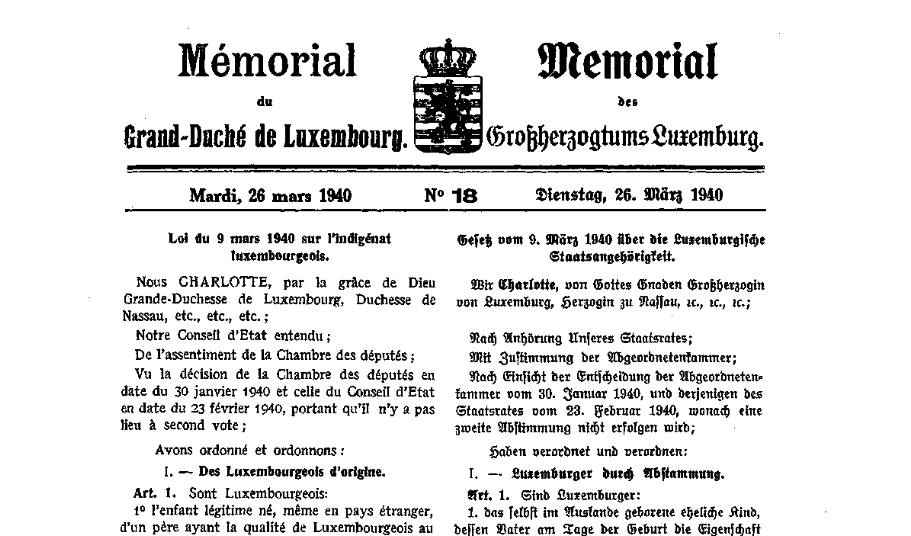
Image: The Mémorial of 26 March 1940, publishing the Law of 9 March 1940 on Luxembourgish nationality in French and German. The law withdrew the protections women had gained in 1934, two months before the German invasion.
The Napoleonic Foundation
According to Luxembourg’s Ministry of Justice’s statistics, in 2022, 668 American adults obtained Luxembourgish citizenship through an ancestor alive on January 1st, 1900. But these numbers actually hide much larger total growth. There are various paths to obtain proof of Luxembourgish citizenship through ancestry.
According to the National Registry of Physical Persons (RNPP), since 2018, the number of Luxembourgish citizens in the United States has increased from 3,602 to 14,972. This increase of 11,370 citizens is equivalent to 316% growth over five years.
As of December 2023, the United States is the fifth foreign country in the world with the most Luxembourgish Citizens. It comes in just behind Germany and before Switzerland.
And these numbers are guaranteed to grow. A few hundred Americans are still eligible to travel to Luxembourg and claim citizenship under Article 89 before December 2025. Additionally, other paths to obtain Luxembourgish citizenship remain open.
From the Treaty of Vienna to the First Constitution
The Grand Duchy of Luxembourg came into existence following the Treaty of Vienna in 1815. In the period immediately after, Luxembourg adhered to the Napoleonic or Civil Code inherited from the French Republic. Notably, it was not until 1841 that Luxembourg established its own Fundamental Law, and the adoption of a constitution did not occur until 1848.
Under its provisions, a child born to a Luxembourgish father — whether within Luxembourg’s territorial bounds or abroad — would acquire Luxembourgish nationality on the basis of jus sanguinis. Conversely, Article 12 of the Code stipulated that a woman who married a foreigner would assume her spouse’s nationality. Compounded by the prohibition of dual or multiple nationality, this resulted in the loss of her Luxembourgish nationality.
1934: The First Comprehensive Nationality Law
It was not until 1934 that Luxembourg enacted a comprehensive nationality law, then referred to as the “law on the indigenous”. At this juncture, women gained a mechanism for preserving or regaining their nationality upon marrying a foreigner.
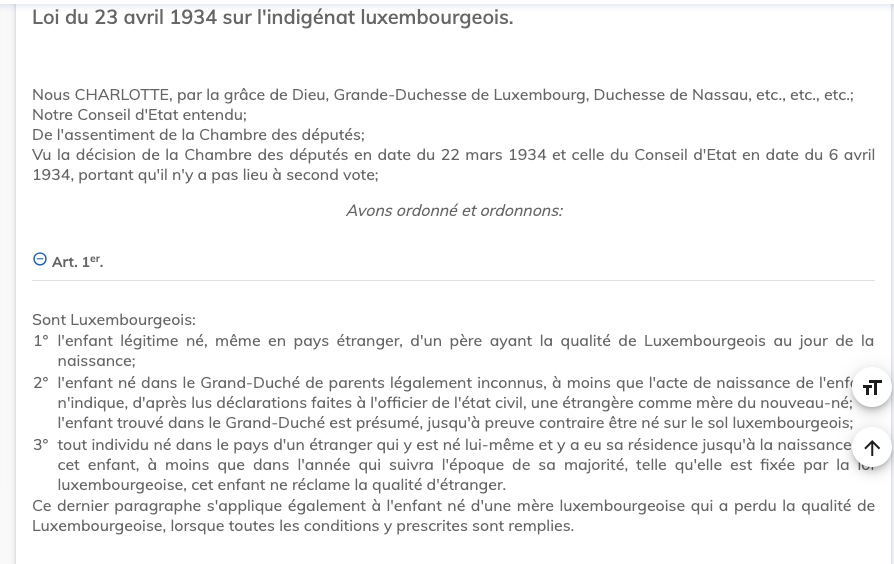
Image: Article 1 of the Law of 23 April 1934 on Luxembourgish nationality. Nationality still passed through the father: a legitimate child was Luxembourgish if “born to a father who held Luxembourgish nationality on the day of birth,” even when born abroad.
1940: Wartime Rollback and Statelessness
That provision was subsequently revoked in the shadow of the Nazi invasion of 1940, further exacerbating the challenges faced by Luxembourgish women in maintaining their nationality.
Throughout Luxembourg’s history, many women lost their Luxembourgish nationality. Due to situations including divorces and conflicts between legal systems, women occasionally became stateless.
1968: Women Retain Their Nationality on Marriage
Only in 1968, with the introduction of the initial “Law on Luxembourgish nationality”, did women gain the possibility of retaining their Luxembourgish nationality when marrying a foreigner, even if they acquired a foreign nationality concurrently.
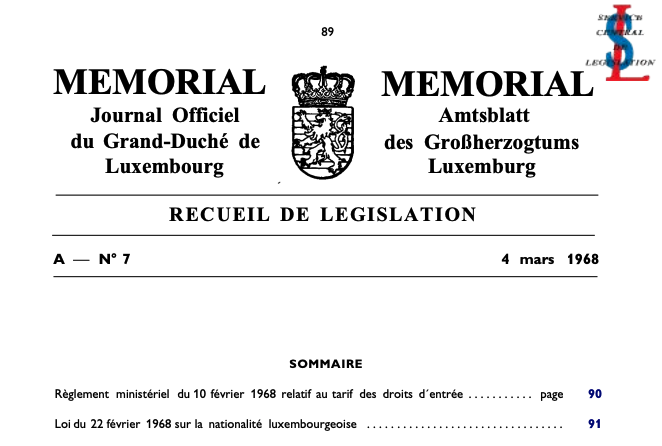
Image: The Mémorial of 4 March 1968 lists the Law of 22 February 1968 on Luxembourgish nationality, the first law to let Luxembourgish women keep their nationality when they married a foreigner.
1986: Women Transmit Nationality to Their Children
In 1986, another significant development occurred, granting women the ability to transmit their Luxembourgish nationality to their offspring, rather than transmission being solely contingent on the father’s nationality. This change applied retroactively to all minor children born on or after 1 January 1969.
2008: Dual Nationality and the Right of Recovery
The watershed moment arrived in 2008, when Luxembourg implemented its first nationality law allowing any Luxembourgish national to hold multiple nationalities. An integral feature of this law was the opportunity for women who had lost their nationality, or their descendants, to reclaim Luxembourgish nationality, provided they completed their applications within ten years of the law’s enactment.
Anyone with a direct lineal ancestor — male or female — who was alive and possessed Luxembourgish nationality on 1 January 1900 could reclaim Luxembourgish nationality themselves. Remarkably, the lawmakers of Luxembourg likely could not have foreseen the profound implications and popularity of this provision.
Between 2009 and early 2017, the following numbers successfully reclaimed Luxembourgish nationality under this law:
| Country | Reclaimed 2009 – Early 2017 |
|---|---|
| United States | 577 |
| Brazil | 277 |
| Argentina | 14 |
2017: Article 89, Article 23, and the Deadlines
A decade later, in 2017, Luxembourg’s nationality law underwent another revision. This revision transformed Article 29 into Article 89 and incorporated additional provisions.
The process for reclaiming Luxembourgish nationality was a two-step procedure: first the validation of the ancestor’s Luxembourgish nationality, and subsequently an in-person application in Luxembourg for the individual seeking to recover the nationality. The 2008 law set a single deadline for both steps, allowing the Ministry of Justice to continue accepting initial applications right up until the final deadline.
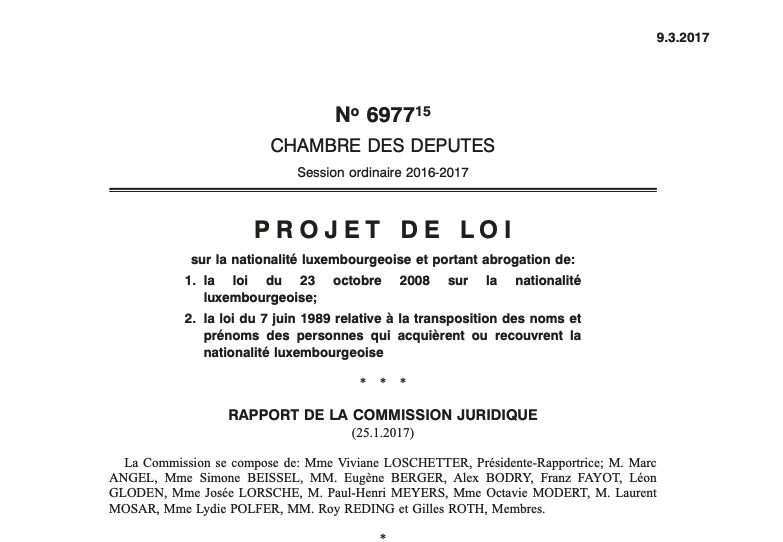
Image: The Legal Affairs Committee’s report on Bill No. 6977 (25 January 2017). The bill replaced the 2008 nationality law and became the 2017 law that introduced the recovery route in Article 89 and the parent-or-grandparent route in Article 23.
That situation would have left some valid applicants unable to complete the second step — the in-person citizenship declaration — before the final cut-off date. To address this, the deadline for the first step was left at 31 December 2018, while the deadline for the in-person declaration process was extended first to 31 December 2020 and finally to 31 December 2025.
Both of those deadlines have now passed. Applications under the first step closed on 31 December 2018, and the final in-person declarations closed on 31 December 2025, bringing this recovery route to a close. The figures below therefore describe a window that is no longer open.
Within the time frame from 2017 to 31 December 2022, the following adults successfully reclaimed Luxembourgish nationality under Article 89:
| Country | Article 89, 2017 – 31 Dec 2022 (Adults) |
|---|---|
| Brazil | 7,988 |
| United States | 2,604 |
| Argentina | 34 |
The 2017 law also introduced an intriguing aspect in Article 23, affording individuals with a parent or grandparent who possesses or possessed Luxembourgish nationality the option to acquire Luxembourgish nationality through a procedure akin to that outlined in Article 89. Over the period from 2017 to 31 December 2022, the following adults exercised this right:
| Country | Article 23, 2017 – 31 Dec 2022 (Adults) |
|---|---|
| United States | 254 |
| Brazil | 180 |
| Argentina | 27 |
Recognition: Those Who Were Already Luxembourgish
At least since 2017, when some individuals initiated the application process for Luxembourgish nationality, the Ministry of Justice determined that they were in fact already born as Luxembourgish nationals. This determination was contingent upon their ancestor being male and their lineage comprising exclusively male individuals in each preceding generation leading up to them. Commencing from 1 January 1969, the criteria extended to females, allowing them to transmit nationality as well.
In such instances, the individual was not applying for Luxembourgish nationality as such, but was instead seeking their initial certificate of Luxembourgish nationality, proving that they were already a national. Notably, the Ministry of Justice does not release statistics pertaining to these proceedings. However, our estimation suggests that from 2018 to 2022 this category encompassed:
| Country | Estimated Recognitions 2018 – 2022 (Adults and Minors) |
|---|---|
| Brazil | 7,612 |
| United States | 5,836 |
| Argentina | 154 |
The limited availability of public information makes it unclear whether this recognition of nationality was a direct consequence of the 2017 law or was in application before. What is clear is that this is by far the greatest source of “new” Luxembourgish nationals in the Americas.
Unlike the recovery deadlines described above, this route is not time-limited. It is the subject of a pending case before the Court of Justice of the European Union, which we follow in Kirchberg Watch.
Because the average person is likely not familiar with which part of the Luxembourgish nationality law permitted them to obtain dual nationality through ancestry, we did not pose any questions to this effect in our survey. We therefore cannot distinguish which of the three routes above our 1,174 survey respondents used.
A Note on Methodology
Outside the STATEC data on Luxembourgers emigrating and the Ministry of Justice’s statistics on nationality procedures, no other public entity in Luxembourg publishes data explaining how else RNPP data shows such a large increase in Luxembourgish nationals living in the Americas. The Ministry of Justice’s statistics concern only adult applicants and not their minor children. We use our estimate of 32% minor children to estimate the number of minor children of adults acquiring Luxembourgish nationality under Articles 89 and 23, adding an additional 32% to the Ministry’s statistics, and determine the remaining difference with available public data sources — which would equal the number of people directly receiving Luxembourgish nationality certificates. Without estimating minor children under Articles 89 and 23, the unexplained difference as of 30 June 2023 is 16,382 people.
A fuller account of how we collect and treat this data is set out in our research methodology.
Sources
- Scuto, Denis. La Nationalité Luxembourgeoise (XIXe–XXIe Siècles): Histoire d’un Alliage Européen. Preface by Gérard Noiriel, Éditions de l’Université de Bruxelles, 2012. ISBN 978-2-8004-1523-9.
- Luxembourg, Ministry of Justice. “Les Statistiques en Matière de Nationalité Luxembourgeoise.”
Adapted from The LuxCitizenship Study 2024, chapter 11: History of Luxembourgish Nationality Law and Dual Nationality.