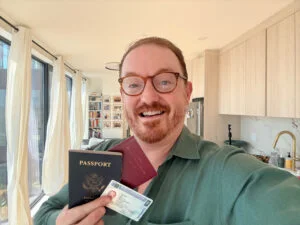


Those who know me know that my path to citizenship work wasn’t entirely linear. Before LuxCitizenship existed — before I’d ever helped a single client obtain their Luxembourg passport — I was a college senior, newly fluent in the French language, fresh off a year studying in Paris and hungry to prove what I was capable of.
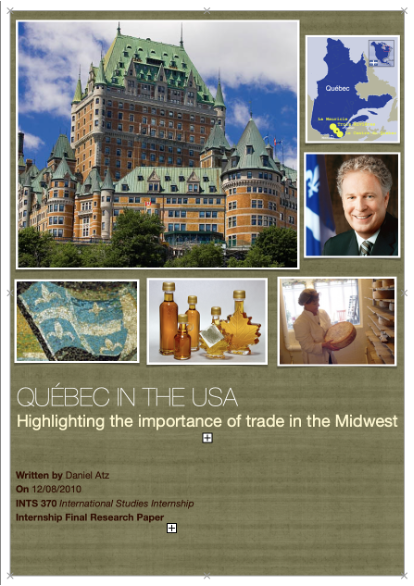
My first professional landing spot? The Delegation of Quebec in Chicago.
It was there that I got my first real taste of a French-speaking world outside of France, and I’ll be honest, the Quebec French was an adjustment. But it was one of the most formative experiences of my professional life.
I worked on promoting maple products across the Midwest, built relationships with farmers and artisans, and came to understand, in a very practical way, the deep economic and cultural ties that bind the Great Lakes region to Canada: the shared waterways, the cross-border communities, the family stories that don’t stop at the 49th parallel.
That experience never left me. In the years that followed, I visited Quebec multiple times, stayed connected to Canadian communities abroad, and continued to carry a genuine affection for the country.
A Pattern We’ve Noticed for Years
Well, fast forward a few more years and pounds than I would like to admit.
Here at LuxCitizenship, we’ve been helping Americans recover their Luxembourg ancestry for over ten years. And in that time, we’ve uncovered a fascinating genealogical pattern that we’d wager most of our clients don’t expect: a considerable number of Luxembourgers first emigrated to Canada before later crossing into the United States.
The story typically unfolds like this: a Luxembourger arrives in Canada, often Ontario or Quebec early on, Saskatchewan a bit later in history. A generation or two later, someone in that family is born in Canada and then migrates south to the US, frequently through Michigan, drawn by work opportunities in the industrial Midwest. A birth certificate from Montreal. A marriage record from Ontario. A death record from Quebec. These Canadian vital records often form a critical link in the chain connecting our American clients to their Luxembourg heritage.
In addition to these Americans, we’ve also helped around 20 Canadians apply for Luxembourg citizenship, although many of these were children or grandchildren of people who migrated to Canada more recently, usually due to marriage with a Canadian spouse.
In 2025, we opened 912 new Luxembourg citizenship cases. Looking across our active client base, we estimate that roughly 3-5% of our clients have some direct Canadian connection, whether they were born in Canada themselves, hold Canadian citizenship, or have a direct-line ancestor with a birth, marriage, or death event on Canadian soil. Over ten years and more than 3,000 clients served, that adds up to a meaningful community.
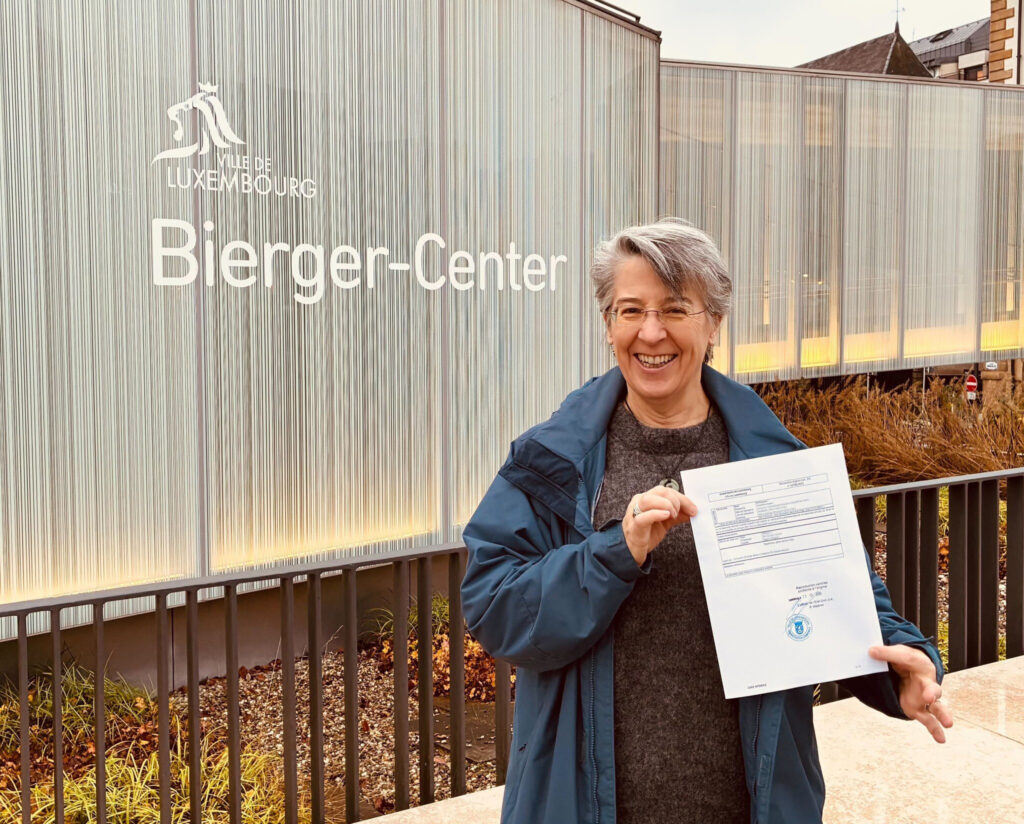
We’ve helped countless Americans and Canadians alike navigate vital records in both English and French, across archives on both sides of the border. Canada, in many ways, has always been part of what we do.
A New Door Just Opened
On December 15, 2025, Bill C-3 (An Act to Amend the Citizenship Act) came into force, allowing people born before that date who would have been Canadian citizens if not for the old first-generation limit to now apply for proof of citizenship.
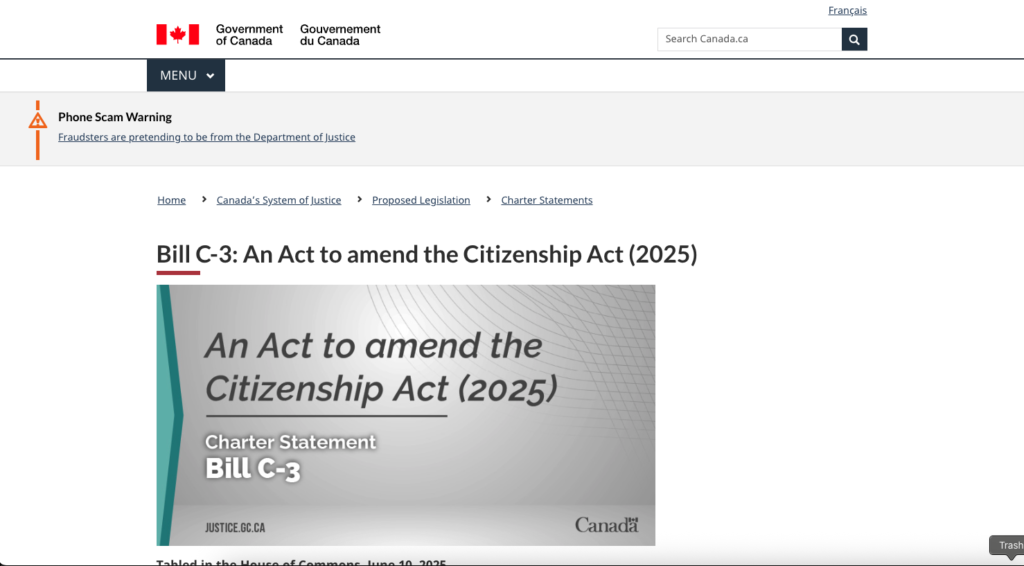
To understand why this matters, a bit of background: under legislation in place from 2009 to 2025, a Canadian citizen born abroad could not pass their citizenship on to a child who was also born abroad. Only the first generation born outside of Canada to a Canadian was a Canadian citizen.
This change came after a December 2023 Ontario Superior Court of Justice ruling that declared the first-generation limit unconstitutional. The 2025 reform now allows millions of Americans to be recognized as Canadian retroactively, as if the old limit never applied. This restoration applies only to those born before December 15, 2025; different eligibility rules apply for children born after that date.
In practical terms: individuals with any direct lineage ancestor born in Canada may now be eligible for Canadian citizenship by descent, provided they were born before December 15, 2025.
Importantly, this is citizenship by descent, not naturalization. It’s automatic if you meet the criteria. You don’t “apply for citizenship”; you apply only for proof of the citizenship you already hold. In many ways, we see parallels with Luxembourg’s Article 7 citizenship pathway.
It Turns Out This Is Personal: For Our Own Team
When we started looking more seriously at Canadian citizenship by descent, we quickly realized the opportunity wasn’t just relevant to our clients. It hit close to home. Our Executive Director Michelle DeFayette‘s grandfather, Wilfrid DeFayette, emigrated from Ottawa to the US. Michelle herself has a longstanding connection to Canada; she interned for the Canadian embassy in Washington, DC, earlier in her career.
When Bill C-3 passed, Michelle didn’t just take a professional interest. She’s now navigating the process herself, working through the very documentation and archival research that many of our clients will face.
We are learning by doing, which has always been our model.
We’re already learning firsthand what this process looks like: the records requests, the generational documentation, the nuances of the Canadian citizenship framework. And we’re bringing those learnings directly to our clients.
What This Means for the LuxCitizenship Community
We have spent a decade becoming deeply fluent in ancestry citizenship: in the records, the archives, the bureaucratic rhythms of governments on both sides of the Atlantic. Canadian citizenship by descent is a natural extension of that work because it builds on our experiences navigating vital record systems in all 50 US states and all Canadian provinces. Our existing expertise in vital records research across English and French-language archives in Canada, and our experience guiding clients through long, document-intensive citizenship processes puts us in a strong position to help.
We believe many of our current and former clients, and many Americans who haven’t yet worked with us, may already be Canadian citizens without knowing it.
Join Us: Free Webinar in Two Weeks
As a first step, on April 11th at 1:15 PM EDT, we will be hosting a dedicated webinar where we will cover:
- How Canadian citizenship by descent works under Bill C-3
- Who is likely eligible (including the Luxembourg-Canada-Michigan genealogical pathway)
- What documents are needed and where to find them
- How LuxCitizenship plans to serve clients seeking Canadian citizenship alongside or independent of their Luxembourg case
This webinar is open to current LuxCitizenship clients and anyone referred by a LuxCitizenship client.
We invite those interested in learning more to complete the registration form below. You can use this form to sign up to attend the live webinar or to receive a recording to watch at your convenience. Those who register for the April 11 session will receive a calendar invite in the days leading up to the event, and all registrants will be given access to the recording once the webinar has concluded.